


 Find additional Shakespeareances
Romeo and Juliet
In-the-Moment Teenage Passions
American Shakespeare Center, Blackfriars Playhouse, Staunton, Virginia
Saturday, September 20, 2025, C–6 (center stalls)
Directed by K.P. Powell
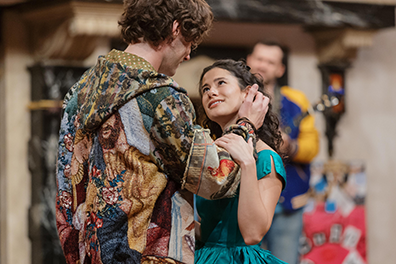
Nick Ericksen as Romeo and Isabel Lee Roden as Juliet share their first moment in love during the Capulet's party in the American Shakespeare Center's production of William Shakespeare's Romeo and Juliet at the Blackfriars Playhouse in Staunton, Virgnia. Britt Michael Gordon plays the guitar in the background. Photo by Lindsey Walters.
It’s the high school jocks versus the arts crowd. In a frenetic yet endearingly sweet staging of William Shakespeare’s Romeo and Juliet at the American Shakespeare Center’s Blackfriars Playhouse in Staunton, Virginia, the ultimate tragedy is a generation of teens failing to look beyond their current moment in life.
That notion has always been there in Shakespeare’s text. Romeo drinks the poison just minutes—just seconds in some productions—before the reportedly dead Juliet awakes in the Capulets' tomb. Juliet, seeing no life beyond Romeo (she’s 13 in the text, maybe 17 in this production) takes her own life with Romeo’s knife. This production makes these kids’ lack of pausing for just a moment a palpable tragedy which goes beyond contemporary dress (actually, early 2000s) and speaks to our nation's contemporary youth suicide epidemic.
That’s quite a heavy takeaway for a production that is full of comedy and breathtaking energy. That, however, is also the nature of youth of any generation, from Shakespeare’s time to the early 2000s to ours. It also is so very K.P. Powell, a veteran American Shakespeare Center actor making his directorial debut at the Blackfriars. The characters he’s played at the Blackfriars, from Hotspur to Macbeth, often exhibited explosive impatience in performances built on his thoroughly studied grasp of the text. We get our first big taste of his Romeo and Juliet’s comic-energy-in-a-tragedy bearings with the opening brawl, which might be taking place in the high school cafeteria (Blackfriars uses no sets) where anything at hand is used as a weapon, including a plastic water pitcher.
Hard for me at 67 to think of 25 years ago as a different epoch—the “oughts” seem like only yesterday to me—but in his director’s notes, Powell reveals exactly why he set his version in that timeframe: that’s when he first read Romeo and Juliet in school, the first play he’d ever read.
“The words gave me one of the most profound realizations of my life: Shakespeare’s characters are just like me!” Powell writes in his director’s notes. “I couldn’t believe that a man that long dead had written speeches that I wanted to copy word for word in hopes Monica would go to Homecoming with me." It also was a time when words mattered in kids’ society, “When slam poetry was everywhere,” Powell writes. “When emo music had a death grip on us teens as we tried to convince our parents ‘you don’t feel as deeply as me!’ Rom-coms were no longer ‘chick flicks’ but the perfect date movie.”
Without stage scenery—except homemade montage posters hanging on the back wall—Powell provides various clues to the high school setting. Isabel Sanchez plays Chorus as a student reading the play. The Apothecary (Maya Danks) is a high school drug dealer wearing hooded jacket and backpack, providing Romeo the poison as subtly as possible while constantly eyeing their environs.
The costumes designed by Elizabeth Wislar has the Capulets wearing blue and yellow letter jackets and the Montagues in eclectic styles of multiple shapes and colors. Romeo (Nick Ericksen), for example, is in yellow pants with lines of shredded fabric stacked on both legs and a jacket featuring a patchwork of designs. Benvolio (Geoffrey Warren Barnes II) wears baggy pants boasting large, colorful flowers on a brown background, a blue Shakespeare t-shirt, and a green fatigue vest with “I do but keep the peace” stitched in gothic lettering down the back. By contrast, Juliet (Isabel Lee Roden) spends most of the play wearing a velvet blue track suit, its only adornment being “Juliet” posted in silver glitter across her butt. At the party, she is wearing a multilayered, knee-length puffy dress that looks like a stack of blooming green and blue crepes paper.
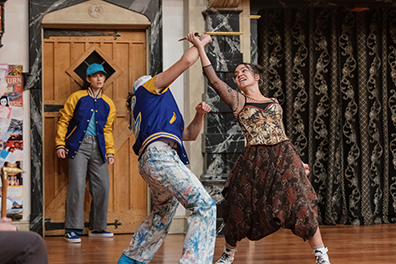
Mercutio (Sara Linares, right) and Tybalt (Joe Mucciolo) share their final moment of hate while the Capulet-clique's Sampson (Isabel Lee Roden) watches in the American Shakespeare Center's production of William Shakespeare's Romeo and Juliet at the Blackfriars Playhouse. Photo by Lindsey Walter.
Powell’s direction makes an astute point about Shakespeare’s play. Known through the ages as the standard-bearer of all love stories, Romeo and Juliet is, in fact, one of Shakespeare’s more violent scripts, starting with a brawl over the mere fact that these guys belong to this house and those guys belong to that house. The relentless hatred between the factions makes it so easy to transport to modern times. Nevertheless, at its heart, Romeo and Juliet is, indeed, the greatest of love stories in part because it has a lot of love to give in the face of such hatred. “Hate seems as loud as it’s ever been,” Powell writes in his director's notes, “but R&J reminds us that love can be just as loud.” Fittingly, the pre-show music performed by the cast begins with Stevie Wonder’s “Love’s in Need of Love Today.”
And, my goodness, love is loud in this production, visually as well as aurally, from the alcohol-fueled friendship of Benvolio and Mercutio (Sara Linares wearing a black-net sleeved ornate bodice, multipatterned loose dress, and white sneakers) to the courting conversations between the title characters. Romeo hits on Juliet with a slow dance, and they immediately measure each other by their words (famously structured in Shakespearean sonnet form). Assured she is willing to be kissed, Romeo hits the line “Then move not, while my prayer's effect I take,” and they engage in a tentative but affectionate first kiss. Back to the words: he has purged his sins on her lips, and her lips now having his sins, he suggests she gives him back his sins, hint, hint kiss me again. Their second kiss is long and sumptuous and seen by the Nurse (Maya Danks).
Romeo is all over the place in the balcony scene, literally. When they part the first time, he departs the playhouse through the audience; when Juliet enters and calls for him, he answers from the lobby. The scene opens with a great visual gag: when Romeo first addresses her, Juliet wields a hair curler as a weapon on “What man art thou that thus bescreen'd in night so stumblest on my counsel?” Later, when she warns Romeo of the danger he’s in, he shouts the line “Let them find me here,” but scrambles to hide as we hear a “hey!” from off-stage and Barnes as a security guard steps out asking “Who’s there?” He only sees the audience and, after he motions that he's watching us and we better take care, he retreats to let the lovers do their scripted thing.
Roden and Ericksen remind us what a great script it is. “My bounty is as boundless as the sea, my love as deep; the more I give to thee, the more I have, for both are infinite,” she says, and we swoon along with Romeo. He loves her wit that this scene displays so clearly. After she has called him back from the lobby, the two engage in the “forget” dialogue, their words swelling from their initial love throes into such eye-resonating sweetness that it took me back to a moment of parting from my now-wife Sarah early in our courtship. I don’t remember our exact words, but those spoken by Roden and Ericksen on the balcony fill in just fine.
Juliet: I have forgot why I did call thee back.
Romeo: Let me stand here till thou remember it.
Juliet: I shall forget, to have thee still stand there,
Remembering how I love thy company.
Romeo: And I'll still stay, to have thee still forget,
Forgetting any other home but this.
Linares plays Mercutio as strung out on some sort of drugs. She’s all nervous energy. With the Queen Mab speech she plays a trick on those of us who have seen this play countless times (well, I count—this is number 40 I’ve seen on stage). About two-thirds through the speech, Linares’s Mercutio turns dangerously melancholic to the point that Romeo starts worrying about her and goes to her aid, whereupon she reveals she’s putting on an act. That’ a nice sendup of interpretating this speech as Mercutio having a psychological breakdown, which I’ve seen too many productions do. To me that’s reading way too much into Mercutio showing off his vivid imagination and ability to take friendly insulting to incredible heights. So, thank you, K.P., for Linares’s Mercutio sending up over-interpreting directors.
Joe Mucciolo plays Tybalt with a sense of cool, the description of “fiery” in the text referring more to his blade than his attitude. The exception: he is far more demonstrative toward his Uncle Capulet (Christopher Seiler) than he is even with Romeo. Perhaps he’s exhibiting his role as top jock in the company of nerds as he publicly takes on his doesn’t-get-it family patriarch. Tybalt’s fight with Mercutio is unusually one-sided, Tybalt mostly defending himself from Mercutio's frantic thrusts. During the fight, Mucciolo’s Tybalt lunges at Romeo and Mercutio intervenes. Nice directorial touch, as it illustrates Mercutio’s care for Romeo as well as his fighting skills. It also heightens the irony of Romeo’s intervening with Mercutio trying to get at Tybalt. “Why the devil came you between us?” the physically and emotionally devastated Mercutio demands. “I was hurt under your arm.” In the follow-on fight with Tybalt, Romeo is quick to apply the fatal stab, but in a seemingly uncharacteristic outburst of rage, Romeo slashes Tybalt three times. These are kids of the early aughts, remember, wearing their passions as their sleeves.
Romeo is the one who delivers the Powell-referenced line, “Thou canst not speak of that thou dost not feel.” He says it to Friar Laurence (Angela Iannone), who would soon rail a sermon at him that provides the generational perspective this production thematically pursues: “I thought thy disposition better temper'd,” the friar says to Romeo, and continues:
Hast thou slain Tybalt? wilt thou slay thyself?
And slay thy lady that in thy life lives,
By doing damned hate upon thyself?
Why rail'st thou on thy birth, the heaven, and earth?
What, rouse thee, man! Thy Juliet is alive,
For whose dear sake thou wast but lately dead;
There art thou happy. Tybalt would kill thee,
But thou slew'st Tybalt: there art thou happy.
The law that threaten'd death becomes thy friend
And turns it to exile: there art thou happy:
A pack of blessings lights up upon thy back,
Happiness courts thee in her best array;
But, like a misbehaved and sullen wench
Thou pouts upon thy fortune and thy love:
Take heed, take heed, for such die miserable.
Iannone’s ferocity, which we have seen earlier this year in her King Lear, paralyzes the audience as she roars these furious verses with such clarity, intensity, and, yet, benevolence, too. The performance earns her an exit applause.
Another character who demonstrates tough love—and I emphasize the latter word, love—is Capulet as played by Blackhouse long-timer Seiler. Many productions portray Capulet as tyrannical to the point of physically abusing Juliet when she refuses to marry Paris (after she secretly married Romeo). Seiler plays that scene as confused: “Soft! take me with you, take me with you, wife: How! will she none? Doth she not give us thanks?” Capulet says. Seiler follows the punctuation suggesting he’s trying to comprehend how his always obedient daughter is suddenly defying him. Underlying his purpose in marrying Juliet to Paris is setting her up in a situation of wealth and comfort, the life she’s always known. That’s an extension of his love, though we and both Juliet and Nurse can see that as enforcing a chauvinistic perspective denying her right to choose. Throughout, Seiler plays Capulet as a loving father, including this scene where that love leads to his anger at her rebuff. I hate to say, but this is normal parent behavior.
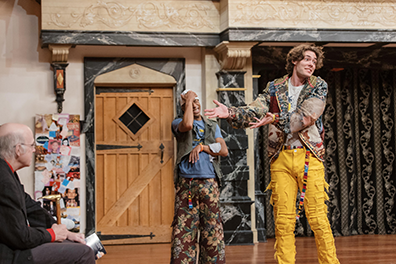
Romeo (Nick Ericksen, right) and Benvolio (Geoffrey Warren Barnes III) use members of the audience watching the play from on-stage "gallant stools" as props for the rest of the Blackfriars Playhouse patrons in the American Shakespeare Center's production of William Shakespeare's Romeo and Juliet. Photo by Lindsey Walters.
Another attribute Powell brings to the production is his experience with the Blackfriars Playhouse. The world’s only re-creation of Shakespeare’s indoor theater, it has no stage lights, only house lights that stay on throughout the performance, as was the case with Shakespeare’s outdoor and indoor spaces for which his plays were written. Blackfriars productions use no electronic or digital applications: special effects are accomplished by human means, and even the music is all acoustic. Perhaps most importantly, both for replicating Shakespeare’s environment and maximum enjoyment of his plays, the stage is surrounded on three sides by the audience, including audience members sitting on “gallant stools” on either side of the stage itself. This means direct address to and interacting with members of the audience.
After Benvolio and Romeo learn of the Capulet masque, Benvolio hatches the plot for Romeo to attend the party to compare his crush, Rosaline, to “all the admired beauties of Verona.” He refers to a woman on a gallant stool as Rosaline, who becomes the ongoing exemplar of their conversation. When Nurse, who recognizes Romeo, disdainfully identifies the girl he just made out with, his next line is seemingly the rhetorical question, “Is she a Capulet?” Ericksen, however, asks the audience, and waits for its affirmation. Relative to most productions I’ve seen, Danks is a young Nurse—no reason she should be old, given her late daughter would have been the same age as Juliet—but Juliet refers to her among the “old folks, many feign as they were dead; unwieldy, slow, heavy and pale as lead.”
Then again, any parent, including surrogates, is old to a teenager. That’s true today, true in the 2000s, true in the 1970s when I was a teen, and apparently true in the 1590s, too.
Eric Minton
March 3, 2026


![Allie Babich wearing a white t-shirt with long black sleeves and tights with one leg red and the other yellow sits on the stage playing a toy piano in The Complete Works of William Shakespeare (Abridged) [Revised] (Again).](../../shakespeareancesimages/Complete_Works-Babich.png "Complete_Works-Babich") ASIDE: Making a Come Back
ASIDE: Making a Come BackOne of the prime delights of the 2025 American Shakespeare Center's artistic year was the return of fan-fave actors Chris Johnston (The Comedy of Errors), K.P. Powell (Romeo and Juliet), Aidan O'Reilly (The Two Gentlemen of Verona), and Allie Babich (The Pirate Ballad of Bonny & Read) to the Blackfriars Playhouse. Great actors all who have left indelible memories with their multiple performances in this space over the years.
This time, though, we don't see these skilled actors on the stage, except in audience talkbacks. Their tenure this year has been directing the above listed plays. It is one of the many brilliant moves Vanessa Morosco has made since she took over as American Shakespeare Center's Executive Director at the beginning of 2024.
She gives one primary reason for these veteran actors' turns as directors in a note in the season's playbill. "They know the Blackfriars Playhouse inside and out—every seat, every sightline, every heartbeat of a live performance," she writes, calling them "artists who understand exactly how to make this stage sing for every audience."
That's a singularly important point. The Blackfriars is a singular theatrical experience, and while some elite directors have tackled plays here and brought much intelligent rigor and creative efforts to the texts, they have often done so without the inculcation of the American Shakespeare Center's specific purpose: to present the plays of Shakespeare and his contemporaries by the production standards and restrictions they had in the 16th and 17th centuries, and even apply those practices to more modern pieces. Though what I'm about to write may sound counterintuitive, such practices make for more vibrant, engaging productions than modern, high-tech takes on Shakespeare et al.
What impresses me most about Morosco's strategy is how she has paired each director with a specific play. Comic genius Johnston directed The Comedy of Errors with his full understanding of how to blend the play's slapstick foundation with the play's serious take on the human condition. Powell, often cast as high-energy brawling romantics, gets at the balance of passionate love and hate Shakespeare presents in Romeo and Juliet. The no-nonsense acting style of O'Reilly is the perfect approach for unlocking and revealing the mysteries that make The Two Gentlemen of Verona such a problem play for directors trying to find a romantic comedy in it. Babich, an outstanding musician in addition to being a master at movement on stage, tackles the shanty-heavy, swashbuckling musical that mixes characters from two different centuries.
The results support Morosco's statement in the playbill. "It's artistic innovation in action, building the future of [the American Shakespeare Center] with the talent that has grown right here." And, I must add, using that talent to discover for us more ways to make what's old so new. —EM
Photos at top from left: Allie Babich in The Complete Works of William Shakespeare (Abridged) [Revised] (Again) by Adam Long, Daniel Singer, and Jess Winfield (photo by October Grace Media); K.P. Powell as Hotspur in Henry IV, Part One (photo by Lindsey Walters); Aidan O'Reilly as Petruchio in The Taming of the Shrew (photo by October Grace Media); Chris Johnston as Arial in The Tempest (Photo by Lindsey Walters).
Comment: e-mail editorial@shakespeareances.com
Start a discussion in the Bardroom
